Bought a Cushion. Naturally, Let's Build a Couch.
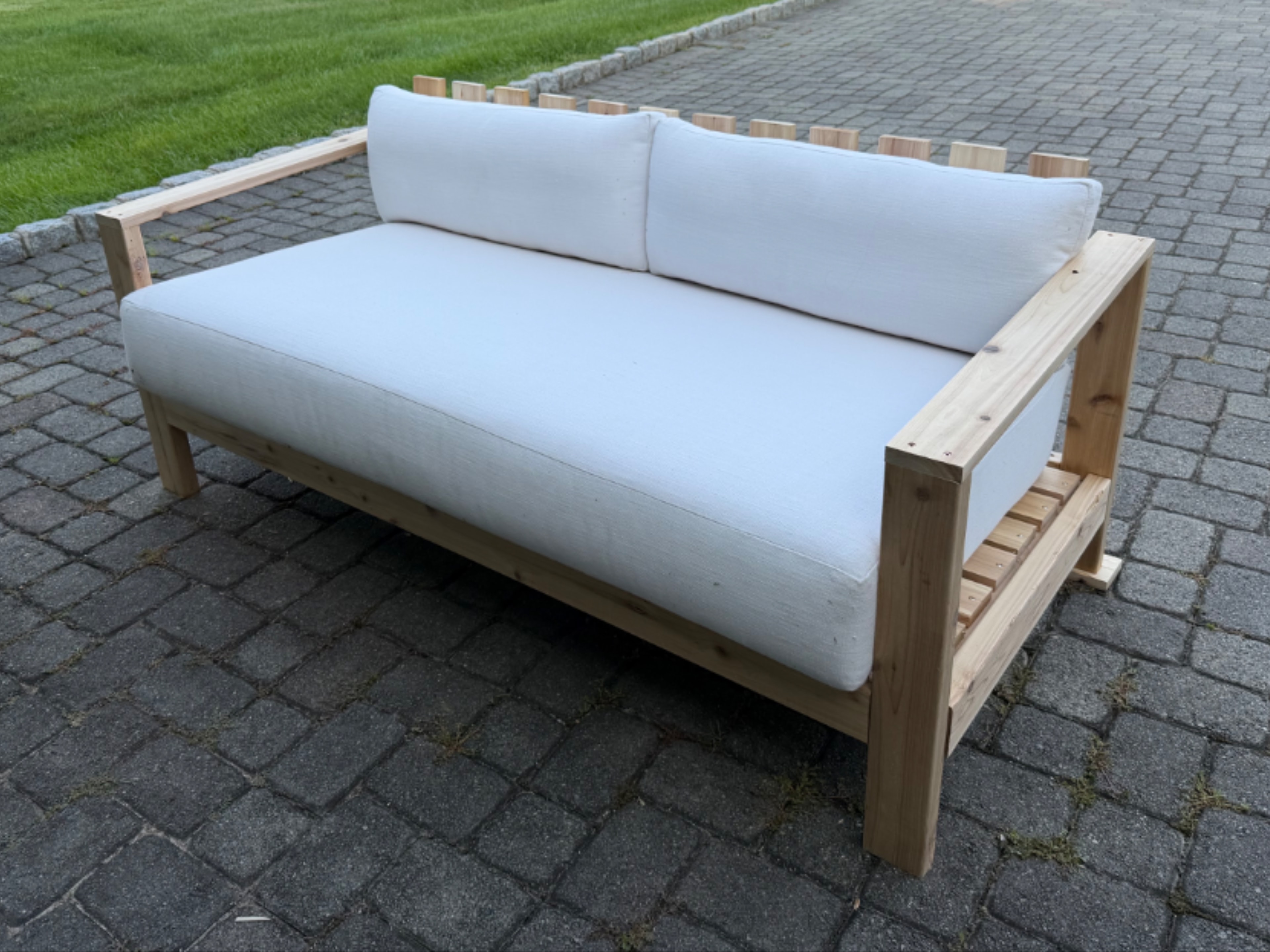
It all started with a $75 Restoration Hardware cushion sitting alone at the outlet. No sofa. No problem. Obviously the logical move was to build an entire cedar loveseat around it.
You know those moments where you convince yourself you're saving money?
This is one of those stories. (But come on, have you seen the prices at Restoration Hardware?)
It all started with the Restoration Hardware outdoor cushion we found sitting all alone in the outlet. Seventy-five dollars. An absolute steal... if you happened to own the matching sofa.
We did not.
So, naturally, I decided the logical thing to do was build an entire cedar loveseat around it.
Because that's obviously cheaper than buying the couch.
(Trust me, I've done the math.)
First Stop: The Lumber Yard
Every good project starts with a lumber run, and this one was no different. A quick shout out to 18 Lumber. There's just something about pulling into the yard and seeing rows of hardwoods, moldings, and trim that gets the creative wheels turning. If you've ever been excited by perfectly stacked lumber, you're my kind of people.
By the time we got home, the cedar was strapped down, and Teddy — my mini-Labradoodle — had happily claimed his spot next to a pile of eight-foot boards that fit perfectly in the back of the car as if riding home with lumber was just another Thursday.
Why Cedar?
Since this loveseat is destined to live outside, cedar was an easy choice.
It's naturally resistant to moisture, insects, and rot, which means it'll hold up to New Jersey summers, surprise thunderstorms, and whatever pollen apocalypse decides to arrive each spring.
It also smells fantastic while you're cutting it, which almost makes you forget how much sawdust is now covering everything you own.
Almost.
Trust the Process
The goal wasn't to copy a Restoration Hardware design — and in fact, I don't think this cushion belongs to a couch this generic.
It was to build something that looked intentional, felt solid, and fit the space.
Once the first cuts were made, the project stopped feeling like a pile of cedar boards and started looking like actual furniture. That's always my favorite moment — the point where your neighbor stops asking, "What exactly is that going to be?" and starts saying, "Okay... I can actually see it now."
The DIY Secret Weapon: Pocket Holes
One of the first things I reached for wasn't a saw (or should I say a hammer) — it was my pocket hole jig.
If you've never used one, picture drilling a hole at roughly a 15-degree angle into one piece of wood. That angled hole lets you drive a screw into the adjoining board, pulling everything together tightly while hiding the fastener from view.
Pocket holes are one of my favorite techniques because they give you:
- Strong, reliable joints that are perfect for furniture frames
- Hidden screws for a cleaner, more finished appearance
- Faster assembly than many traditional joinery methods
- Less time wrestling with clamps and more time actually building
Could I have spent weeks mastering beautiful mortise-and-tenon joinery?
Sure.
But this is an outdoor loveseat, not the next exhibit at the Smithsonian — although, I question what Restoration Hardware would have done.
Pocket holes win this round. But trust me — I need more practice.
A Lesson in Geometry... Courtesy of My Mom
The frame came together faster than I expected, and I was feeling pretty proud of myself.
Then my mom came over.
Like any good project manager, she volunteered to be the quality control department by sitting on it.
Within about three seconds she looked at me and said, "Why do I feel like I'm sliding off the front?"
Turns out I had built the seat with a slight forward pitch instead of the back pitch.
In my defense, it looked perfectly fine at first.
In everyone else's defense, gravity exists.
Thankfully, it was an easy fix before moving on to the next phase. A few adjustments to the frame changed the seat angle, making it much more comfortable and far less likely to launch unsuspecting guests onto the patio.
Sometimes the best tool isn't a fancy power tool.
Sometimes it's your mom saying, "This doesn't feel right."
There's still plenty left to do — sanding, solid stain finish — but the sofa is... well, a sofa.
And somehow, that lonely $75 cushion has officially become a piece of the backyard.
No regrets.
...Oh wait, spoiler — we have a second cushion to match this one!
Stay tuned for more detail on me trying to repeat this process.